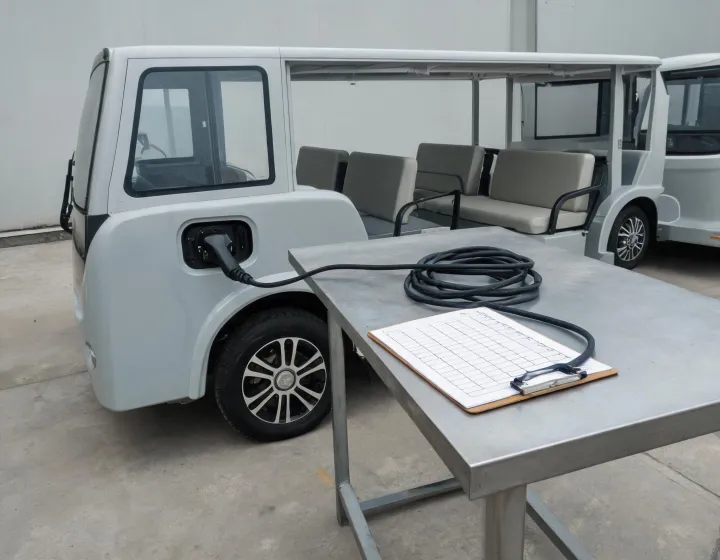
Does a four-wheel electric cart with a 25 mph top speed actually count as a low-speed vehicle under federal rules? Yes, if it meets three limits at once: four wheels, a speed attainable in 1.6 km (1 mile) of more than 32 km/h (20 mph) and not more than 40 km/h (25 mph) on a paved level surface, and a gross vehicle weight rating under 1,361 kg (3,000 lb). Those are the only three conditions in the federal definition, and they buy less than most buyers assume.
The common misread is that hitting those numbers makes a vehicle street-legal and roughly as safe as a small car. Neither follows. The federal definition sorts vehicles into a class and sets a minimum equipment list for the ones used on public roads. Which roads those are, and whether your state will register the thing at all, gets decided somewhere else.
Three Numbers Decide If It Is an LSV
Start with the shape. The definition requires four wheels, so a three-wheeled electric runabout sits outside the class no matter how slowly it moves. That single word removes an entire product category from the conversation, and it catches people who assume the federal rule is really about speed.
Then speed, where the measurement conditions carry as much weight as the number. The rule asks for the speed attainable in 1.6 km (1 mile) on a paved level surface, above 32 km/h (20 mph) and not more than 40 km/h (25 mph). A downhill run, a helpful tailwind or a dashboard display that momentarily reads 25 does not answer the question. The figure has to describe what the vehicle can reach on flat pavement over that distance.
Weight is the third test, under 1,361 kg (3,000 lb). Two of the three tests are numbers a spec sheet can settle before anyone forms an opinion about the vehicle. So what happens to the machines that miss the speed window at either end?
Why the Class Stops at 25 MPH
Take the ones that can go faster. Commercially available electric vehicles have to meet the Federal Motor Vehicle Safety Standards and go through the same rigorous safety testing as conventional vehicles sold in the United States, and the low-speed electric class is the exception carved out of that requirement. A four-wheel electric vehicle that can exceed the 25 mph ceiling no longer fits the terms of the exception. Build it to run above that ceiling and the lighter path closes to you.
The floor behaves the same way in the other direction. A vehicle that cannot get past 20 mph fails the definition too, which surprises owners who assume slower must be safer and therefore automatically covered. It is covered by nothing here; it is simply not an LSV, and its legal situation turns on other rules entirely.
Neither edge tells you how any particular model was actually certified or tested. That comes from the manufacturer's paperwork for that model, not from the class definition.
GVWR Comes From the Manufacturer's Label
Which weight figure gets compared against the 3,000 lb ceiling? Not the curb weight, and not whatever the scale at the yard said after you loaded it. GVWR is the value the manufacturer specifies as the loaded weight of a single vehicle. The sticker on the vehicle is the number that counts; your scale is not.
That distinction has teeth. Two vehicles with a similar footprint, battery pack and cabin can land on opposite sides of the line because their makers rated them differently. One rated a little under the ceiling sits inside the class. Its near-twin rated a little over does not, and careful loading does not move the label.
So the question for a seller is not how much the thing weighs. Ask what GVWR the manufacturer assigned it, and whether that rating is printed on the vehicle's own label where you can read it before purchase.
LSV, NEV and Golf Cart Are Not the Same Thing
Where do neighborhood electric vehicles and golf carts sit against that definition? Department of Energy guidance describes low-speed electric vehicles, also called neighborhood electric vehicles, as the class held to less-stringent standards because they are typically limited to low-speed roadways as specified by state and local regulations. NEV reads as a familiar label rather than a separate federal category with its own rulebook, so a listing that says NEV and nothing else still has to clear the same three limits.
Golf carts sit further out. A four-wheel cart whose attainable speed stays at or below 20 mph never clears the floor of the speed band, so the federal LSV class does not describe it, whatever its owners do with it on private property. What such a cart may do on a given public road is a state or local matter, and that question is separate from the federal definition.
The Equipment List Is Shorter by Design
What does an LSV actually have to carry? The stated purpose of the standard is to ensure that low-speed vehicles operated on public streets, roads and highways are equipped with the minimum motor vehicle equipment appropriate for motor vehicle safety. Minimum is the operative word, and the class is explicitly subject to less-stringent standards than the safety standards and testing that conventional electric vehicles go through.
The lighter rule set is why the class exists at all. It is also why the vehicle is not a small car. The minimum equipment list is a floor, not a safety rating. A dealer who says the vehicle meets the federal low-speed standard has told you it carries the required equipment, and nothing about how it would behave in a crash with a much heavier vehicle.
For a fleet operator the consequence is a separate risk decision. Suppose a campus loop where everything moves at 15 mph and a connector road where traffic runs 45. The equipment floor may be plenty on the loop. On the connector the same vehicle is a different proposition, and the federal class gives you no help weighing it.
Federal Definition Does Not Grant Road Access
So does meeting the definition give the vehicle a right to use public roads? No. The federal text answers a class question and an equipment question. Actual use is tied to roadways specified by state and local regulations, and the standard speaks about low-speed vehicles operated on public streets without opening a single one of them.
The questions worth carrying to a dealer or a state motor vehicle office are concrete. Which roads in my county allow this class, and at what posted limit? What does the state want in the way of title, registration and insurance? Does it add equipment, a permit or a plate beyond the federal minimum? Does the label on this specific vehicle show both its GVWR and the class the maker built it to?
None of those answers travel with the federal definition. They change at the state line and sometimes at the city limit, so two identical carts can be routine in one town and unusable ten miles down the road. That leaves you with the trade this class is built on: a light, inexpensive machine held to a short equipment list instead of full crash standards, in exchange for doing the road-by-road homework yourself. Do that homework before the money changes hands, not after.

Leave a comment
Do not include confidential procurement data in a public comment. Use the inquiry form for sourcing requirements.