-
The Federal LSV Equipment List, Item by Item
-
What the Minimum-Equipment Floor Really Commits You To
-
Why Minimum Equipment Logic Drives Fleet Maintenance Cost
-
Where an LSV Ends and a Golf Cart Begins
-
Rear Visibility and the Alert Sound Requirement
-
What a Buyer Can Verify at Delivery
-
Does Meeting the Minimum Mean the Vehicle Is Safe?
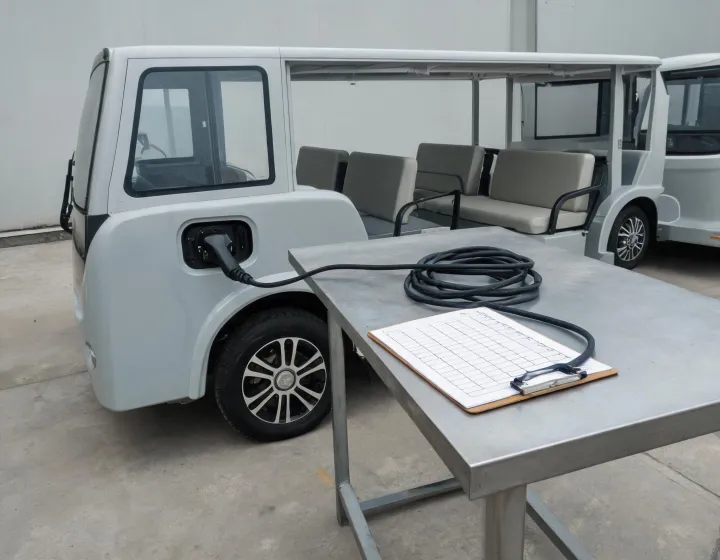
Picture two low-speed vehicles coming off the same truck and sitting at the same receiving gate. One is signed into service before lunch; the other sits in the yard for three days because a single listed item is missing or dead and nobody owns the fix.
The list behind both outcomes is 49 CFR 571.500, the federal rule setting minimum equipment for low-speed vehicles, as republished by Cornell's Legal Information Institute: lamps, reflectors, mirrors, a parking brake, glazing, belts at every designated seating position, and cross-references for rear visibility and an alert sound. None of that is a rating. Every line is a discrete part that can be missing at delivery or fail later, which is why the operator's question is not whether a unit is compliant but whether every named part can be sourced and replaced.
The Federal LSV Equipment List, Item by Item
The text is more specific than most spec sheets. Each low-speed vehicle must carry headlamps; front and rear turn signal lamps; taillamps; stop lamps; reflex reflectors, one red on each side as far to the rear as practicable plus one red on the rear; an exterior mirror on the driver's side and either a passenger-side exterior mirror or an interior mirror; a parking brake; and a windshield conforming to the federal glazing standard at 49 CFR 571.205. Item ten adds a Type 1 or Type 2 seat belt assembly conforming to FMVSS 209, installed at each designated seating position.
The list splits by physical job. Headlamps, turn signals, taillamps and stop lamps are the see-and-be-seen group: they broadcast the vehicle's presence and its intentions, and a dead stop lamp removes the only warning a following driver gets that the unit is slowing. The reflex reflectors are unpowered, which means they keep returning light from someone else's headlamps when the battery, the wiring or the ignition does not. The mirror and the windshield serve the driver's own sightlines. The parking brake holds a stationary vehicle on a grade without relying on the service brake or on a foot staying down. Seat belts are the one item whose job is protecting the occupant rather than preventing the crash.
What the Minimum-Equipment Floor Really Commits You To
The purpose clause reads literally: the standard exists to ensure that low-speed vehicles operated on public streets, roads and highways carry the minimum motor vehicle equipment appropriate for motor vehicle safety. Minimum is the operative word. Nothing there claims the vehicle is well equipped, and nothing in the section assigns an inspection interval, a condition standard or a maintenance schedule. It names parts and stops.
Because it is a floor rather than a schedule, the recurring check lands on whoever holds the asset. The regulator defines the set, the manufacturer installs it once, and the operator absorbs every day on which one of those parts is dark, cracked or seized. A unit accepted in March has no standing in July. The same section also draws a boundary buyers miss: it governs equipment on vehicles in this class and says nothing about whether your state or city permits one on a given road.
Why Minimum Equipment Logic Drives Fleet Maintenance Cost
The cost pattern follows from the part outward. The rule names parts rather than outcomes because a part is either present and working or it is not, which means compliance is binary at inspection while degradation is continuous across every hour of service; the reason that gap shows up as downtime rather than as purchase price is that each listed item is a single point that can hold a unit out of morning release; and it comes down to field-replaceability, because lamps and reflector film sit on one replacement clock while belt hardware and the parking brake sit on another, and those clocks do not fail together.
That is the trap in practice.
Suppose a ten-unit shuttle fleet. Two units are held at release, one for a dead stop lamp and one for a side reflector that let go in a wash bay. Neither fault costs much in parts. Both cost a vehicle-day, a driver-hour and a dispatcher's morning, and the reflector problem repeats because the mounting, not the reflector, is the real fault.
Where an LSV Ends and a Golf Cart Begins
The list is attached to a vehicle class, and the purpose clause ties it to low-speed vehicles operated on public streets, roads and highways. Both halves matter. A cart built and documented for a golf course or a private yard sits outside the class the section describes and is not meant for those roads, so this list does not speak to it. The buyer's first task, then, is to establish what class the unit was built and documented as, before arguing about parts.
Which is why two machines that look identical from twenty feet can carry different obligations. Lamps, mirrors and a windshield tell you what someone installed; the class statement tells you what the unit was built against. The first is hardware you can see, and the second is a document you have to ask for.
Rear Visibility and the Alert Sound Requirement
Two items point outward instead of naming hardware. Low-speed vehicles must comply with the rear visibility requirements in S6.2 of FMVSS No. 111, and must carry an alert sound as required by 49 CFR 571.141. Both are cross-references, and that is how far the captured text goes: it tells you which standard governs, not what the device must be or do.
The consequence is documentary. You cannot settle either question by looking at the vehicle and forming an opinion, because the requirement lives in a document you have not read yet. Get the two referenced texts, or the manufacturer's statement of conformity to them, before treating either item as closed. A camera bolted to the rear panel and a speaker that beeps in reverse are not self-certifying.
What a Buyer Can Verify at Delivery
At acceptance, what you can settle without inventing a test procedure is mostly paperwork plus a walk-around. Ask the seller for the unit's class and equipment statement. Then walk the delivered unit against paragraph (b) of the rule, item by item, rather than against the sales sheet. Confirm that the glazing is documented as conforming to 571.205 and that an FMVSS 209 belt is installed at every designated seating position. Then ask which document covers the S6.2 rear visibility and the 571.141 alert sound.
Suppose a mixed batch arrives from two build lots, eight units in one delivery. A checklist walk tells you which units are missing a listed part today. It does not tell you the condition of a parking brake cable or whether a reflector's adhesive survives a pressure wash. Those are maintenance questions and belong in the PM schedule, not in the acceptance argument.
Does Meeting the Minimum Mean the Vehicle Is Safe?
So a unit that ticks every box — is it safe enough? The purpose clause answers narrowly: the standard is there to ensure that vehicles in this class carry the minimum equipment appropriate for safety on public roads. Presence is what the text guarantees. Condition on the day you accept the unit, and condition a year later, sit outside the list entirely. Because condition sits outside it, your residual risk lives in the gap between all items present and all items working, and no certificate closes that gap.
The move is to bind acceptance and the PM schedule to the same item list, so the parts that show up at delivery are the parts checked on a cycle afterward. And when a listed part cannot be sourced — a reflector with the right mounting, a glazing panel, a belt assembly for a discontinued seating configuration — treat that as a reason to decline the unit rather than a problem to solve later. A vehicle you cannot keep equipped is a vehicle you cannot keep in service.

Leave a comment
Do not include confidential procurement data in a public comment. Use the inquiry form for sourcing requirements.