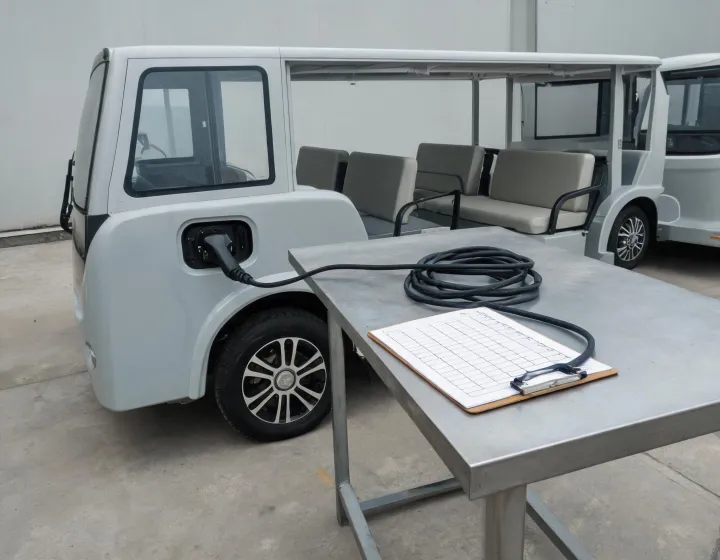
For the GEM vehicles covered in GEM's US FAQ, a battery range estimate is a conditional planning number, not a fixed specification. Run a new pack on flat ground in mild weather with a light load and properly inflated tires, and the published figure can hold. Change the ambient temperature, the grade, the payload, the driver's habits, the age of the pack or the tire pressure, and it will not. GEM names every one of those variables and then says plainly that it is hard to state exactly what your range will be. That sentence is the most useful one on the page.
The productive question, then, is not what the range is but what the range is under your conditions. GEM's battery page adds a second lever — capacity — and the e6 configuration page notes that battery options vary by range, cost and level of maintenance. Read together, those statements point the same way: a figure with no operating profile behind it is an opening position for a conversation with a seller, not a route plan.
The Estimate Is a Condition, Not a Spec
The arithmetic behind any range estimate is short. Usable pack energy in kilowatt-hours, divided by the energy the vehicle spends per mile, gives distance. Both halves of that fraction move. Capacity falls as cells age and as they sit cold, while consumption rises with mass, grade, speed changes and tire deflection. Because both parts of the fraction are variables, the output is a variable too, and calling it a specification does not make it one.
GEM's FAQ sets the company's own ceiling at up to 98 miles (157 km) on a charge, then attaches the conditions in the same breath: ambient temperature, terrain, driving conditions, payload, driving habits, battery age and tire pressure. That list is not hedging; it is the set of inputs feeding the division above. Treat the 98-mile figure as a favorable-case envelope for GEM vehicles, and treat your route as the thing the envelope has to survive.
Battery Capacity Is Only Half the Story
Capacity and range are different quantities, and mixing them up is where a procurement argument starts. Kilowatt-hours measure stored energy. Miles measure distance covered under a particular set of conditions. GEM offers a 16 kWh max range pack that the company says delivers nearly double the range of the standard 8 kWh pack it describes as coming standard in every GEM — a comparison made under comparable conditions, not a conversion ratio that survives a grade or a cold morning.
On the tradeoff itself, my position is simple. If two vehicles run the same loop in the same weather with the same load, the larger pack is the easier answer, and I would not argue otherwise; it carries more work in reserve. But fleet route planning turns on the duty cycle, not on the label, because the label only sets the ceiling. A 16 kWh pack climbing loaded in freezing weather can end a shift with less margin than an 8 kWh pack on flat ground in mild air.
Temperature and Terrain Move the Number First
Cold works on both sides of the fraction at once. A cold pack has higher internal resistance, so more of the energy it releases turns to heat inside the cells instead of reaching the motor, which means the same stored kilowatt-hour returns fewer miles at the wheels. Cold also adds load — defroster, heater, wipers, lights — and that draw comes out of the same pack. Nothing on the label changed. The physics did.
Terrain is a work argument. Raising a vehicle and its occupants up a grade adds gravitational potential energy that the pack has to supply, and the longer or steeper the climb, the larger that term grows. Rough surfaces and repeated stops add losses of their own. GEM's FAQ folds these into terrain and driving conditions. Underneath the wording sits a plain fact: a mile uphill costs more than a mile on the level, and the pack pays the difference.
Payload, Habits, and Tire Pressure Add Up
Every extra pound has to be accelerated from rest and then carried against rolling resistance, so payload and a heavy right foot draw energy that a lighter, smoother run would have kept. Stop-and-go driving is expensive for the same reason: each stop converts kinetic energy to brake heat, and each restart has to buy it back from the pack. The driver cannot recover what the brakes already took.
Tire pressure is the cheapest variable on the list and the one most often skipped. A soft tire deforms more as it rolls, and that flexing turns energy into heat instead of forward motion; the reason a low tire costs range is that the sidewall is doing work the motor pays for. GEM lists tire pressure as a range factor but publishes no figure alongside it, so the pressure that counts is the one specified for that vehicle, not a number borrowed from another model.
Age Degrades the Pack, Not the Label
A pack does not announce its decline. The printed estimate stays where it was while the usable capacity behind it shrinks, and internal resistance climbs with age, which means a larger share of each discharge becomes heat rather than motion. The same route then draws a bigger fraction of a smaller store. That is the mechanism behind a vehicle that once finished a shift with margin and now finishes on the last bar of the gauge.
Battery age appears on that same factor list, and no degradation curve is published next to it. Without such a curve, nobody can honestly tell you the loss at year three or at year five, and a quoted percentage would be a number nobody measured on your vehicle. What you can do is record the distance a full charge actually delivers on a fixed route and compare it month to month. The trend is the data.
What GEM's Evidence Can and Cannot Tell You
All of the above rests on manufacturer material for GEM models sold in the US: the FAQ, the battery and charger page, and the e6 configuration page. The 98-mile figure, the 8 kWh standard pack and the 16 kWh max range pack are GEM's own claims, tied to GEM vehicles under comparable conditions. They are not independent test results and not a specification for low-speed vehicles in general. Another manufacturer's LSV can post entirely different numbers, and nothing here gives you grounds to transfer them.
What the material does establish is the shape of the problem: the builder of the vehicle says several variables move range and offers capacity as one lever among them. That is enough to make an unconditional number useless for planning, and not enough to predict your route. Anything more precise — a range at a stated temperature on a stated grade at a stated load — has to come from the seller's own configuration data or from runs you log yourself, and neither is in this material.
A Route-Specific Range Check You Can Do Today
Before you compare configurations, write down one real route: the distance, the load you actually carry, the grades and surface, the typical temperature during the shift, how your drivers run that loop, the age of the pack in the vehicle you are replacing, and the current tire pressure. That is a short list, and no spreadsheet is required.
Then put the list in front of the seller and ask for a range statement against it. A seller who answers in those terms is showing you how the vehicle was specified. A seller who can only repeat the headline maximum has handed you a number that was never about your operation — and the fair conclusion is that the estimate stays unverified for your use until you run the route yourself and log what the pack gives back.

Leave a comment
Do not include confidential procurement data in a public comment. Use the inquiry form for sourcing requirements.