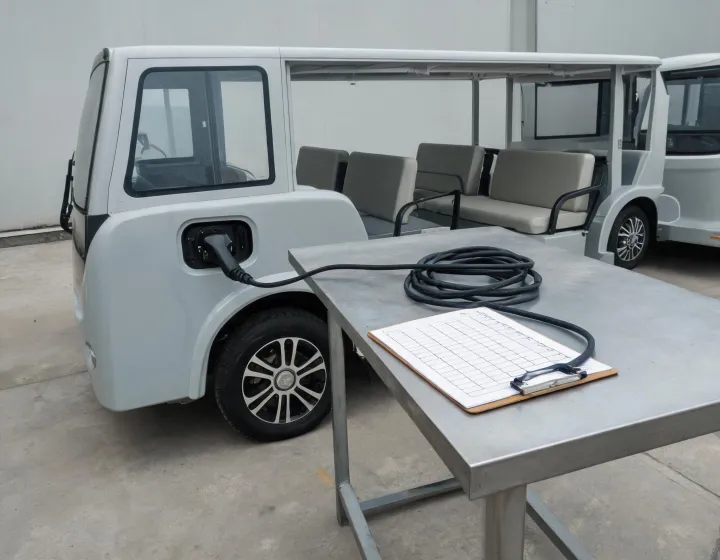
Suppose a resort buys a six-seat electric shuttle and runs it the way the brochure implies: six adults aboard, bags behind the rear bench, a cart on the back step. Nothing dramatic happens on day one. The cost arrives later and in pieces — trips re-routed onto slower service paths, a second smaller vehicle bought to cover overflow, suspension and tire wear showing up ahead of schedule, and a maintenance log that no longer tells you which unit is the problem.
The seat count is the least useful number on that spec sheet. What decides the load is the federal ceiling — an LSV's gross vehicle weight rating has to stay under 3,000 lb — set against the machine's own mass. On the GEM e6, the US configuration page lists a dry weight of 1,481 lb (672 kg) and a payload capacity of 1,518 lb (689 kg). Those are one named model's figures, not a category rule, and they are where the real conversation starts.
When Six Seats Push an LSV Over Its Ceiling
Rarely does that bill arrive as a single incident. It is a route plan rewritten mid-season, a spare vehicle that exists only because one unit cannot be trusted with a full house, and a maintenance record full of complaints that never resolve into a single replaceable part.
So what does an overloaded six-seat shuttle actually cost? Reassignment first, redundancy second, a second purchase order third. None of it appears on the option list, because the two numbers that matter sit in different rows and answer different questions: a ceiling written for the loaded vehicle, and a dry weight written for the empty one. Set them side by side and the empty machine has already taken a large share of the ceiling before the first passenger climbs the step.
GVWR Is the Number the 3,000-Pound Rule Reads
Which figure does the rule actually compare against the ceiling? Not dry weight, not curb weight, and not the payload number on a marketing page. The federal definition of GVWR is the value the manufacturer specifies as the loaded weight of a single vehicle, and the third LSV condition is written against exactly that figure: GVWR under 1,361 kg (3,000 lb). Curb weight is a different animal — standard equipment plus maximum capacity of fuel, oil and coolant, and air conditioning or an optional engine where fitted.
If GVWR is the loaded weight the manufacturer specifies, what does a dry weight figure leave out? Anything added after the measurement: fluids, accessories, the cart on the back step. Curb weight lands closer to reality because it counts standard equipment and full fluid capacities. But only GVWR is the loaded-weight statement the class definition reads, which is why the other numbers cannot stand in for it.
One wrinkle on the e6 page is worth naming. It lists GVW at 3,000 lb (1,361 kg), a round figure, while the rule says less than 1,361 kg. Those two statements should not be reconciled by guesswork, and the page does not attempt it. Put the question to the dealer in writing and keep the answer with the vehicle file.
Where a Six-Seater Stops Being an LSV
Where does a six-passenger vehicle stop being an LSV altogether? Three conditions decide it, and seating is not one of them: four wheels, a speed attainable in one mile above 20 mph and not more than 25 mph on a paved level surface, and a GVWR below the federal ceiling. Miss any one and you are looking at a different class with a different set of obligations.
GEM's e6 page puts the top speed at 25 mph (40 km/h), which sits at the very top of that band rather than in the middle of it. A six-seat shuttle built to run above 25 mph is not a faster LSV; it is not an LSV at all. That is a class difference, not a trim level, and it changes what the vehicle is, how it is registered and who may operate it.
Federal class is also not road permission. Whether a state or locality lets you put the thing on a public street is a separate question with a separate answer, and a dealer who answers only the first one has not answered the second.
Where the GEM e6's 1,518 Pounds Actually Goes
Now do the arithmetic the brochure skips: how much of the payload is left once six riders are aboard? The e6 page states payload capacity at 1,518 lb (689 kg) and maximum cargo capacity at 330 lb (150 kg), and the same page says the shuttle seats up to six. Spread the payload across six seats and the average allowance is about 253 lb per rider before anyone sets down a bag. That is arithmetic on rounded manufacturer figures for one model, not a seating rating.
Two hundred fifty-three pounds is not a large adult.
Six of them is the entire budget.
Run two hypothetical loads: six riders averaging 253 lb consume the payload line outright, leaving the cargo figure nothing to draw on, while four adults plus two children with light gear leave slack — which is why the four-adult pattern is the one these shuttles survive. None of this says the shuttle is badly built. It says the seating claim and the weight claim are two different statements that happen to share a page, and the weight claim is the one that turns up in daily service.
Notice what a per-seat average hides. The driver is a rider too and draws on the same payload. A cart on the back step draws on it before anyone sits down. And an average is a division, not a promise about any individual trip.
Does Payload Cover Passengers, Cargo, or Both
Here is the question the published numbers do not answer: is the 330 lb maximum cargo capacity included inside the 1,518 lb payload, or does it stack on top? Both numbers appear on the page, with nothing said about how they relate. Any answer invented at the desk is a guess about a vehicle you have not bought yet.
Ask in writing, and ask narrowly. Does the payload figure include the driver? Is cargo counted inside payload or separately? At what loaded weight does the manufacturer consider this configuration to be at its GVWR, and what does the certification label on the delivered unit say? If a dealer quotes a number that differs from the label, which one applies to the sale?
These are ordinary purchase questions, not accusations. A fleet that buys six of these and learns the answer the hard way owns six vehicles with the same problem, and the correction cost multiplies by six. One email before the order is cheaper than one re-routing decision after it.
Who Should Not Buy a Six-Seat LSV
A six-seat LSV is the wrong purchase if the honest daily load is six adults plus tools, if the route needs more than 25 mph, or if the property depends on road access the state has not granted. In any of those cases the seat count promises a capability that the weight ceiling and the class definition cannot deliver, and a larger shuttle or a different vehicle class is the answer.
It fits when the real pattern is four adults and light cargo inside a closed site, with the sixth seat used occasionally rather than every shift. For the GEM e6, the weight math holds in that pattern and the six seats are usable rather than decorative.
Buy the weight budget, not the seat count. The seats are what the brochure sells; the payload is what the property lives with every day.

Leave a comment
Do not include confidential procurement data in a public comment. Use the inquiry form for sourcing requirements.